
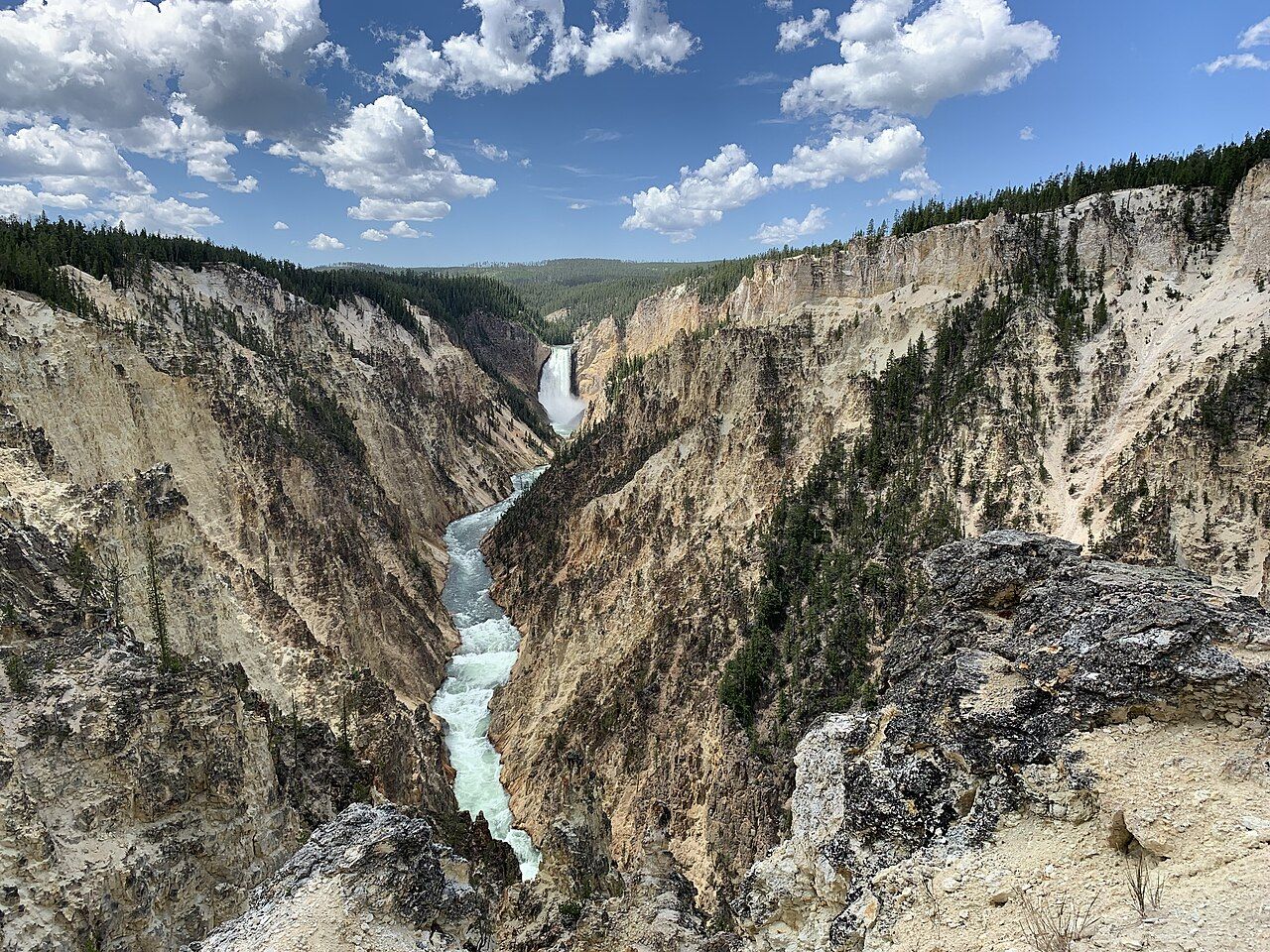
Most of Yellowstone is a high, rolling plateau of lodgepole pine, meadow and steaming ground. Then, a few miles north of Hayden Valley, the river that has been meandering quietly past bison herds suddenly drops off the edge. It goes over the Upper Falls, runs a short distance, and then plunges over the Lower Falls into a canyon whose walls look painted rather than weathered. For a photographer used to the open sagebrush flats of Jackson Hole, it is a complete change of scale and colour, and a place that rewards a second and third visit at different hours.
What makes the rock yellow
The colours are not paint and, for the most part, not sulfur either. The canyon is cut into volcanic rock that hot water and steam have altered over a very long time. That hydrothermal cooking leaches and rearranges the minerals, and iron compounds in the softened rock oxidise into the yellows, oranges, pinks and reds you see on the walls. Some patches still steam today, which is a reminder that the ground here is far from finished.
The river then carved down through this weakened rock with relative ease, leaving steep, crumbling walls, spires and fluted slopes. Exact figures for the depth and length vary depending on where you measure, but the canyon runs for many miles and is several hundred metres deep in its most dramatic stretch. You do not need the numbers. Stand at any railing and the drop does the explaining.
frame info
Domenico Convertini from Zurich, Schweiz · CC BY-SA 2.0The two rims and their viewpoints
The canyon has a North Rim and a South Rim, each with a drive and a string of signed overlooks, short paths and stairways. The North Rim Drive passes several viewpoints that look down on the Lower Falls from above and from the side, and a steep paved path leads to the brink, where you stand right where the river tips over. The South Rim Road leads to the most famous overlook of all, Artist Point, plus trails that follow the edge between viewpoints.
A few notes before you go:
- Some of the paths into the canyon are long series of switchbacks or stairs. They are short in distance but steep, and the climb back out at this elevation is harder than it looks.
- Trails and stairways here are closed from time to time for repair and rebuilding.
- Keep to the boardwalks and marked trails, behind every railing. The rim is loose, undercut rock, and people have died after stepping past barriers for a better angle.
Artist Point, the classic frame
Artist Point is the view most people already know: the Lower Falls framed at the far end of a long V of coloured canyon walls, with the river a green and white thread far below. It is a short walk from the parking area to a stone-walled platform, and on a summer day the railing will be lined with people from mid-morning onwards.
The composition is almost fixed by the geography, so your choices are mostly about focal length and light. A moderate wide angle gives the whole V with the falls small and central. A short telephoto isolates the falls and the brightest band of yellow rock beside them. Turning the camera vertical emphasises the depth of the gorge. A polarizer can cut haze and deepen the sky, but watch it on wide frames, where it can darken one side of the sky unevenly.
Because the canyon runs roughly in a line away from you here, sidelight reaches in at a low angle early and late in the day, and the walls take on depth and warmth. Under high sun the rock flattens and the canyon floor drops into hard shadow. If you only have one session, mornings are a sound choice, both for light and for a quieter platform. Late in the day can be lovely too, though the deeper parts of the gorge lose light early.
Next frameHayden Valley and the bison rut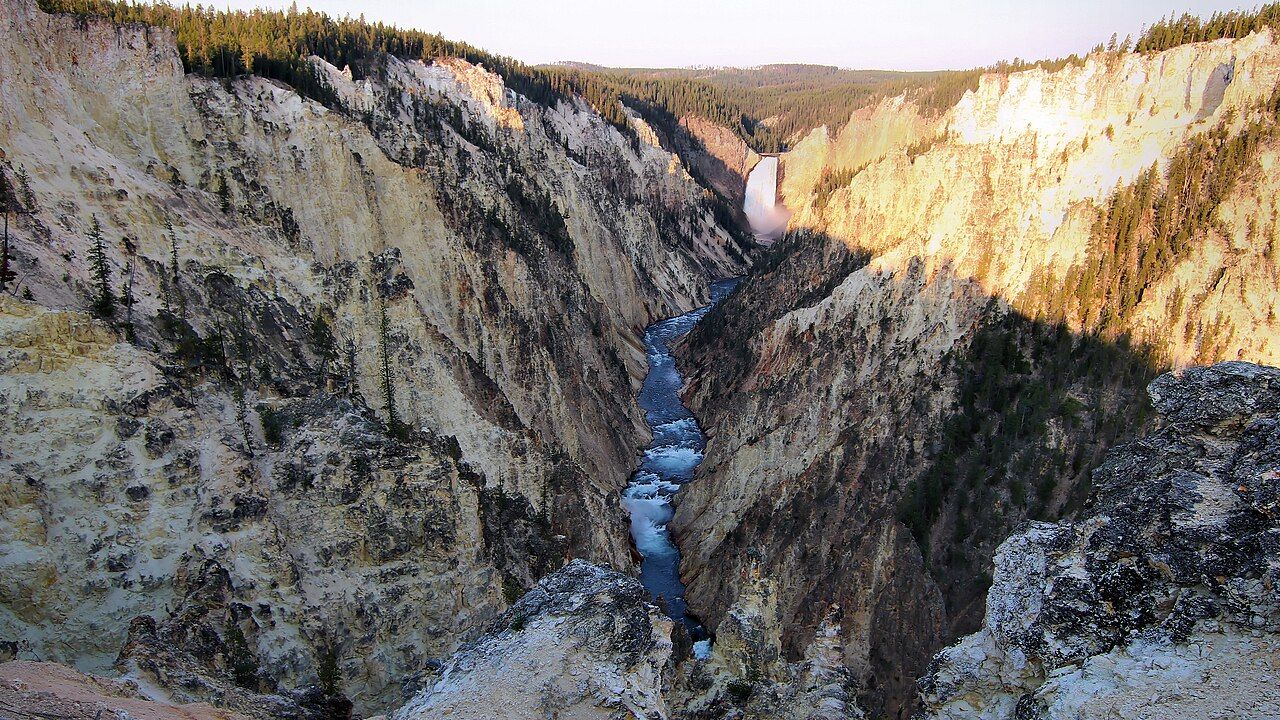
frame info
Larry D. Moore · CC BY 4.0Rainbows in the spray
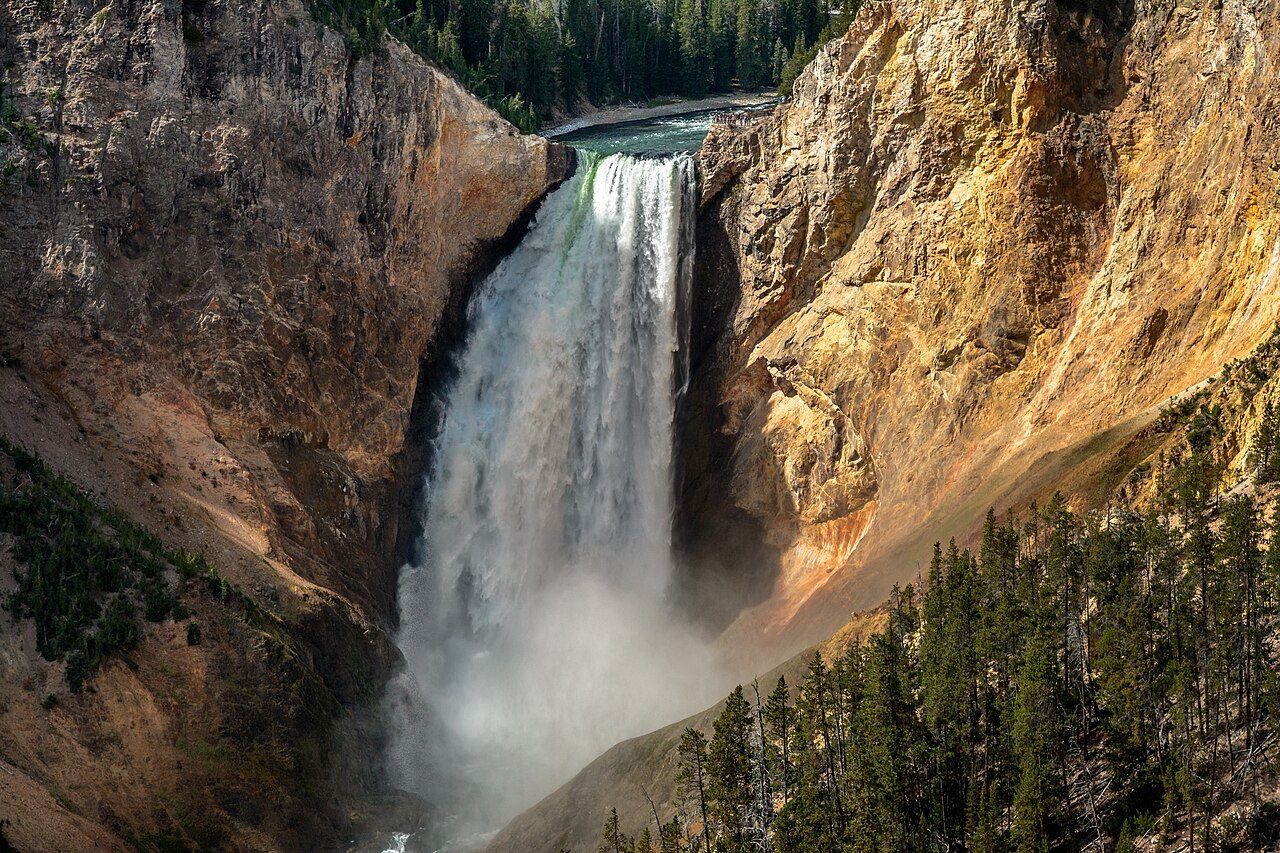
On sunny days the mist rising from the base of the Lower Falls often holds a rainbow. A rainbow only appears when the sun is behind you and the spray is in front, so its position depends on where you stand and on the time of day. From the viewpoints on the North Rim and the overlooks closer to the falls, sunny mornings are when you are most likely to catch one, and it can sit low in the spray or arc right across the plunge pool.
Some practical habits help:
- Arrive with the light, not after it. Rainbows come and go as the sun moves and the wind shifts the mist.
- Use a polarizer carefully. Rotated one way it strengthens a rainbow; rotated the other way it can erase it entirely.
- Expose for the bright water and let the shadows go dark. The white of the falls clips quickly.
- Bring a light shell and a cloth for the lens at the viewpoints nearest the falls, where drifting spray can coat the front element.
Timing your visit
The roads that reach the canyon are open to cars roughly from late spring to autumn, and most of Yellowstone's roads close to ordinary vehicles in winter. The river is at its fullest in late spring and early summer, when snowmelt makes the Lower Falls loud and wide, and the spray at its biggest. By late summer the flow is lower, but the light softens and the crowds thin as autumn comes on.
Mid-summer weather often builds into afternoon thunderstorms over the plateau, which can bring dramatic skies and also lightning on exposed rims. Shelter in your vehicle when storms move in.
If you are pairing the canyon with other stops, it sits on the loop road between the geyser basins to the south and west and the northern range to the north. Many visitors drive it as a midday stop between a dawn in the wildlife valley just upstream and an evening in the geyser country, which is fine for a look but rarely gives the best light. If you can, base yourself nearby for one night so you can stand at the rim at first light.
Beyond the famous view
Once you have the classic frame, look for smaller pictures. The textured, streaked walls make strong abstract compositions with a longer lens. Ospreys have long nested on spires within the canyon in some years, though nests shift and some seasons are empty; if you see one, give it space and use a long lens from the rim. Fog in the early morning can fill the gorge and lift slowly, revealing the falls in stages, which is worth waiting for on cool, still days.
For a sense of how this place fits into the wider region, the canyon is a useful contrast with the open valleys covered in our notes on light through the year. And if steam and colour are what drew you here, the hot springs and geysers of the Upper Geyser Basin and the vast pool at Grand Prismatic Spring are a day's driving away on the same loop. The canyon is a place to slow down, though. Walk a stretch of rim trail between viewpoints and you will find angles that never appear on the crowded platforms.