
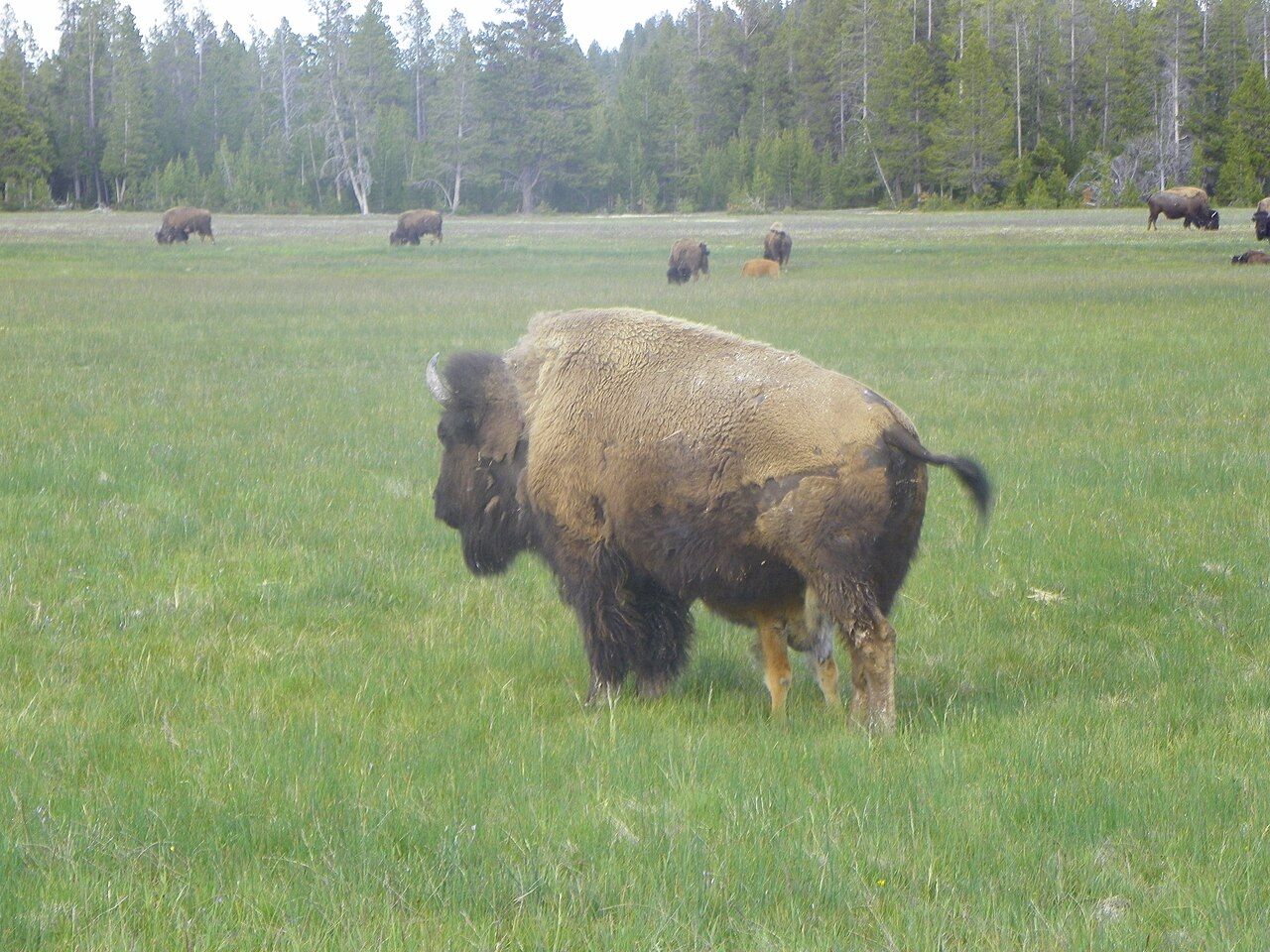
Spend a day in Yellowstone and you will almost certainly see bison: grazing beside the road, lying in the steam of a geyser basin, or walking down the centre line with a queue of cars behind them. They are so common, and so calm-looking, that visitors forget what they are. Bison injure more people in the park than any other animal, including bears. Almost every one of those injuries happens because someone got too close.
An animal built for this country
The American bison is the largest land mammal in North America. Mature bulls can weigh close to a tonne and stand taller at the shoulder than most people. Cows are smaller but still enormous. That bulk sits on a frame that can turn quickly, jump fences and run far faster than any human, often cited at around 30 miles per hour or more over short distances.
Yellowstone is unusual in that bison have lived here continuously since prehistoric times. Across the rest of the continent, the great herds were shot out in the 19th century. By the early 1900s only a tiny remnant, a couple of dozen animals or so, survived in the park, protected from poachers by the army. Managers brought in animals from private herds and ran a ranch in the Lamar Valley to rebuild the population. Today Yellowstone holds several thousand bison, the number rising and falling with winters, management and migration. In 2016 the bison was named the national mammal of the United States.
frame info
Frank Schulenburg · CC BY-SA 4.0Reading the warning signs
Bison usually tell you when you are too close. The trouble is that their signals are subtle, and by the time most people notice them, the animal is already moving. Watch for:
- The tail. A tail hanging down and swishing is relaxed. A tail raised straight up or kinked is a classic warning that the animal may charge or bolt.
- Head and eyes. A bison that stops grazing, lifts its head and turns to face you is paying attention. Head shaking, bobbing or lowering towards you is a threat.
- Pawing and snorting. Pawing at the ground, snorting, grunting loudly or wallowing nearby can all mean agitation, especially in bulls during the rut.
- Short false charges. A sudden run of a few steps towards you is not a bluff to be tested. Back away at once.
If a bison changes its behaviour because of you, you are too close. Back away slowly and put distance, a car or a large obstacle between you. Do not run towards other people or animals.
Distance and the photograph
Park rules in Yellowstone and Grand Teton ask you to stay at least 25 yards from bison and other large animals, which is roughly two bus lengths. That figure is a minimum. If a bison is walking towards you on a boardwalk or trail, it is up to you to move, and quickly.
The good news is that bison photograph beautifully from a distance. A lens in the range of 300mm or longer lets you fill much of the frame with a single animal from well outside the limit. Roadside sightings are best shot from inside your vehicle, using a window mount or a beanbag on the sill, which keeps you safe and keeps the animal calm. Turn off the engine to reduce vibration, and pull fully off the road before you stop. Never block traffic or stand in the road to get a shot, and never get between a cow and her calf.
Light changes everything. Low sun at the edges of the day picks out the texture of their coats and the steam of their breath on cold mornings. Backlight can rim the dust of a wallow or a calf's coat with gold. Midday is harsher, but overcast days suit the dark fur.
Next frameHayden Valley and the bison rutRed calves in spring
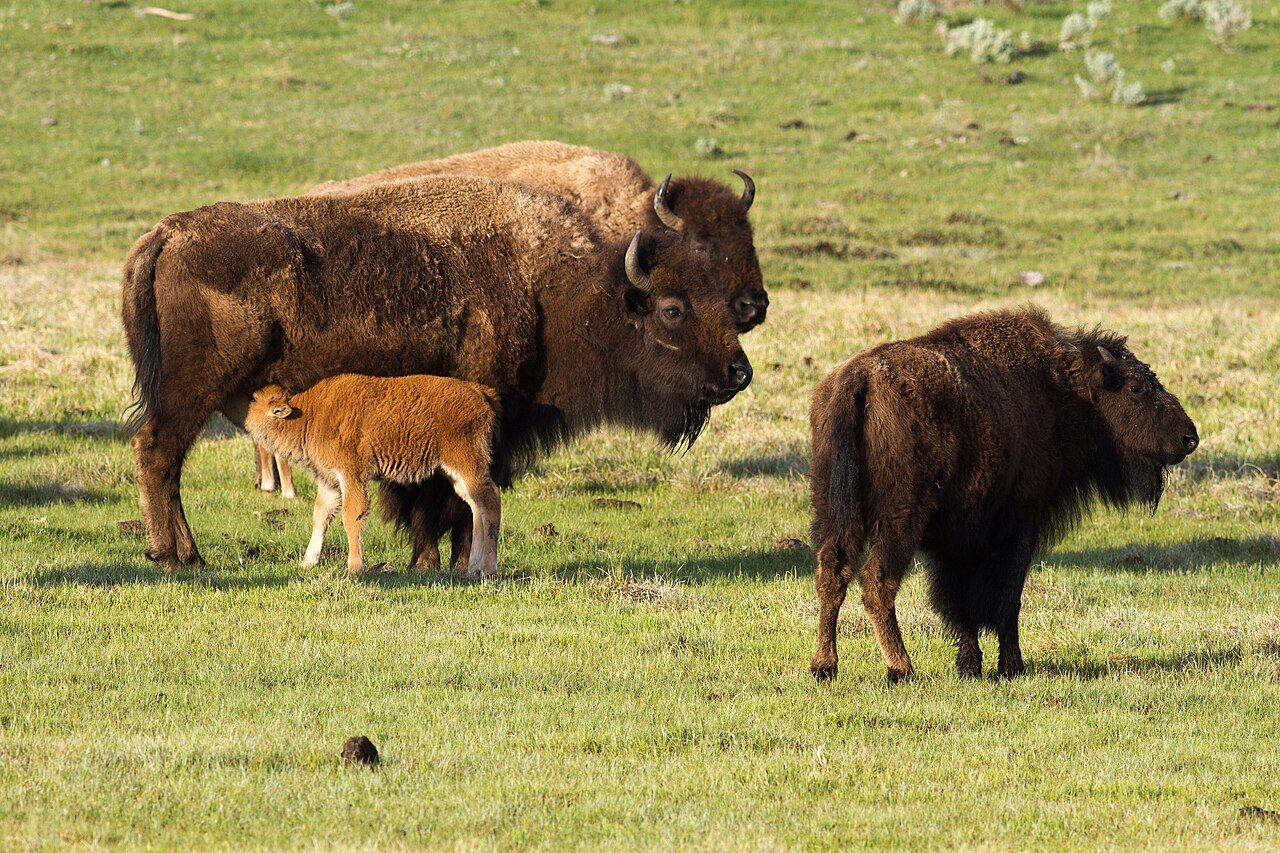
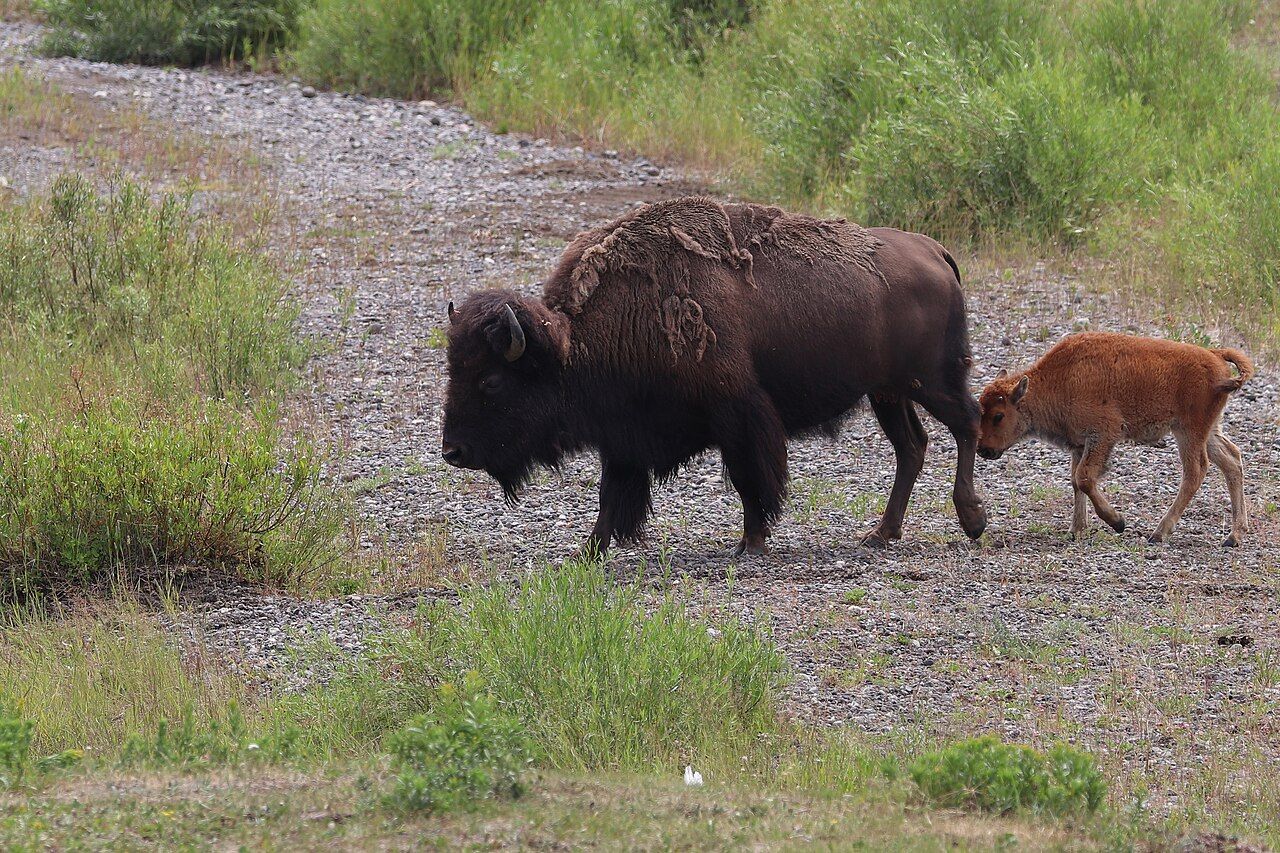
Bison calves are born from around April into June, with a peak in late spring. Newborns are a bright reddish orange and are often called red dogs; within a few months their coats darken and the hump starts to show. In May and June, herds on the northern range and in the central valleys are full of them, playing, nursing and sticking close to their mothers.
frame info
Lucas Golden · CC BY 4.0Cows are protective and herds react as a group. A calf that strays towards a road or boardwalk may draw adults after it. Give mothers even more room than the minimum, and never try to help a calf that seems lost or stuck. In past years well-meaning visitors have handled calves, and the result has been tragic for the animal. If you see a calf in trouble, tell a ranger.
Summer rut and winter survival
From around mid-July into August, bison gather in large herds for the rut. Bulls bellow, wallow in dust, follow cows closely and fight. Valleys such as Hayden Valley and the Lamar Valley are famous for it, and the sound of bellowing bulls carries a long way across the meadows. This is when bulls are most unpredictable, and when the traffic jams are at their worst.
Winter shows bison at their toughest. They swing their massive heads side to side to sweep snow away from grass, and frost builds on their coats, which insulate so well that snow can sit on their backs without melting. Some move to lower ground or to thermal areas where the snow is thinner. Roads open to cars in winter are limited, so the northern range, reached from the North Entrance, is the usual place to watch them in the cold months.
Winter is also a lean time. Animals weakened by deep snow and cold may struggle, and some do not make it. Stay well back from any animal that seems stressed, and do not approach carcasses, which can draw predators.
Bison beyond the park
Many Yellowstone bison move towards the park boundary in late winter and spring, and some cross into Montana, where their management is a long-running and complicated public debate. In Grand Teton, a smaller herd roams the valley floor, and you may see bison along the main roads, on the sagebrush flats and near Mormon Row. The same distance rules apply there.
Wherever you meet them, the lesson is simple. Bison are wild, fast, heavy and indifferent to how good your photograph is. Stay in or near your vehicle, use a long lens, watch the tail, and let them have the road. For more on approaching all of the valley's wildlife responsibly, read our notes on wildlife photography ethics.