
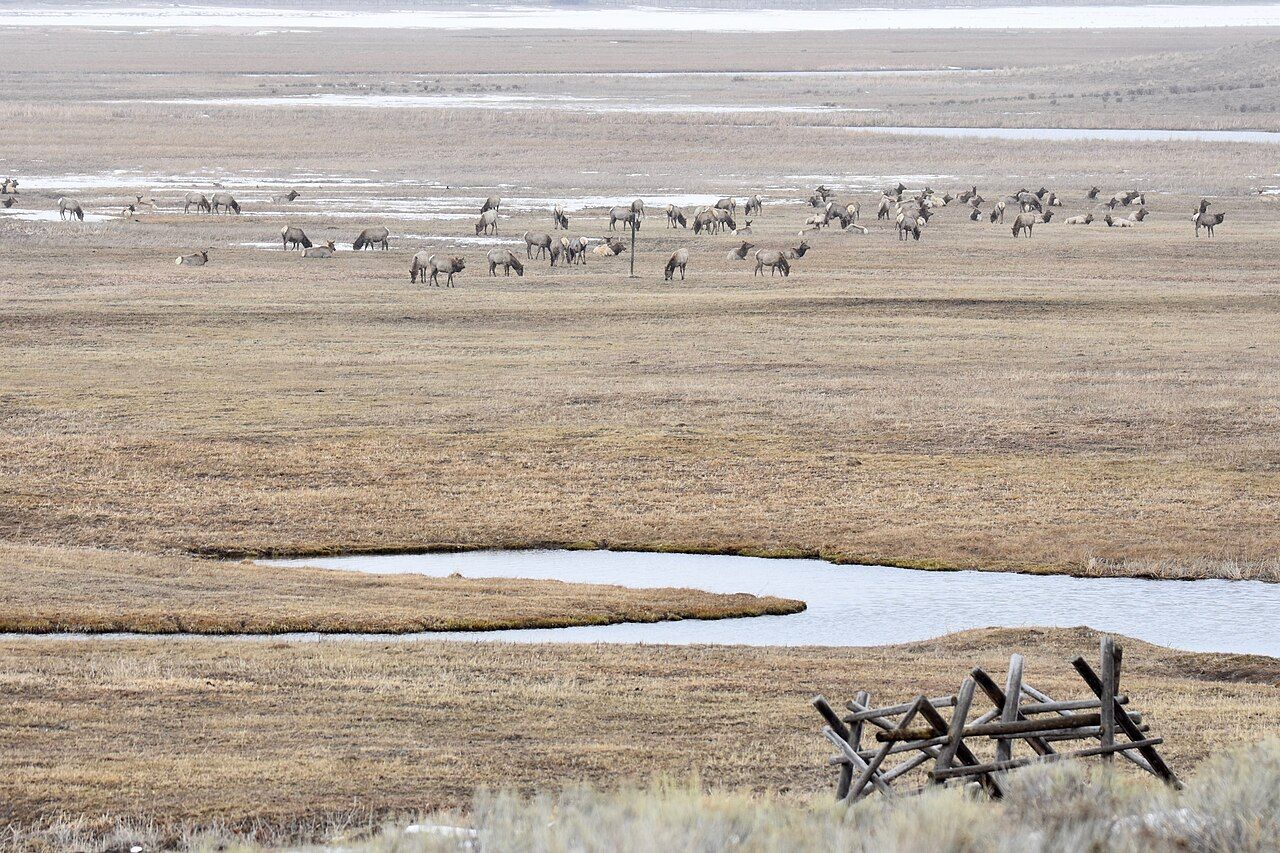

Elk are the animal that ties Jackson Hole together. In summer they disperse into the high country of Grand Teton, Yellowstone and the surrounding forests. In autumn the bulls bugle across the meadows. In winter many of them come down to the valley floor, and a large share of them end up on a broad stretch of marsh and grassland that begins at the edge of the town of Jackson. If you understand that yearly movement, you will know where to look in every season.
The animal and its year
Elk are large members of the deer family. Bulls carry wide, branched antlers that they grow every summer and shed every late winter or early spring. While growing, the antlers are covered in a soft, furry skin called velvet; by late summer the bulls rub it off against trees and shrubs, leaving hard, polished bone ready for the rut.
Cows give birth in late spring, usually tucking their calves into cover. In summer, small herds graze in high meadows. By September the bulls have gathered groups of cows and are defending them from rivals. After the rut, as snow piles up in the mountains, many elk migrate towards lower ground, some travelling long distances along traditional routes.
September and the bugle
The rut runs roughly from early September into October. Bulls bugle, a strange, rising whistle that ends in grunts, to advertise themselves and challenge other males. They wallow, thrash small trees with their antlers, and sometimes clash head on. Dawn and dusk are the busiest times, and cool, still mornings carry the sound a long way.
In Grand Teton, elk often gather in the open meadows and edges of the timber along the park's roads in the north of the valley, and visitors line pullouts in the evenings to listen. Popular areas change from year to year, and in some places rangers manage parking and viewing. In Yellowstone, the lawns at Mammoth Hot Springs are the most famous rut stage of all.
A rutting bull is focused, short-tempered and powerful. Stay at least 25 yards away, more if he is moving, and never get between a bull and his cows. Use a long lens from a pullout and stay close to your vehicle. Do not imitate bugles or use calls to draw a bull closer; it disturbs the animals at a demanding time and goes against park guidance on wildlife.
The National Elk Refuge
The National Elk Refuge was set aside in the early 20th century, after severe winters and the growth of ranching in the valley left elk with little winter range. It stretches north from the edge of Jackson along the east side of the valley, beneath the Gros Ventre foothills, and is run as a national wildlife refuge rather than as part of the parks.
Next frameMoose in the willows
frame info
VjunetXuuftofi · CC BY-SA 3.0Each winter several thousand elk gather there. The refuge has long provided supplemental feed in hard winters, a practice that keeps numbers high but also concentrates animals in ways that raise concerns about disease. How and when feeding happens is an ongoing management question, and policy can change. The visitor centre at the northern edge of town is a good place to ask about current conditions, see exhibits and look out over the marsh.
Much of the refuge is closed to the public in winter to protect the wintering animals. A road along the eastern edge offers some access, though parts of it close seasonally and rules on stopping and walking apply.
Sleigh rides and winter viewing
In winter, horse-drawn sleigh rides take visitors out among the herds on the refuge. The elk are used to the sleighs and often stand close by, which makes for intimate views that are impossible on foot. Arrangements, seasons and costs change.
From the roadside, a long lens still gives you plenty to work with. Look for bulls sparring in the late winter, steam rising from herds on cold mornings, and low sun across the snow. Cloudy days can turn the whole scene into soft greys and browns, which suits the animals' coats. Bighorn sheep sometimes feed on the slopes along the refuge road as well.
Shed antlers and the arches in town
By late winter bulls begin to shed their antlers, and the refuge floor becomes scattered with them. Collecting antlers on the refuge is not open to the public. Instead, local Scouts have long gathered the sheds under permit and auctioned them each spring, with much of the money going back to the refuge. Rules for antler collecting on surrounding public lands are separate and strict, with closures to protect wintering wildlife.
The four arches at the corners of the town square in Jackson are built from thousands of shed elk antlers. They are rebuilt from time to time as antlers weather. They are covered in our guide to Jackson and the valley, and they make a fitting stop after a morning on the refuge.
Photographing elk with care
Some quick habits make elk photography better for you and easier on the animals:
- Work from your vehicle or close to it, especially around roads.
- Watch for cows with young calves in late spring; they can charge without warning.
- Look for elk in the edges between meadow and forest at dawn and dusk.
- Keep backgrounds simple. Snow, sagebrush and dark timber make strong frames.
- Never feed, call or bait elk, and leave antlers where they lie on protected land.
Elk are part of every season in the valley. For a sense of how they fit with the light and weather through the year, see our notes on light and seasons.
End of the roll. Back to the light meter.