
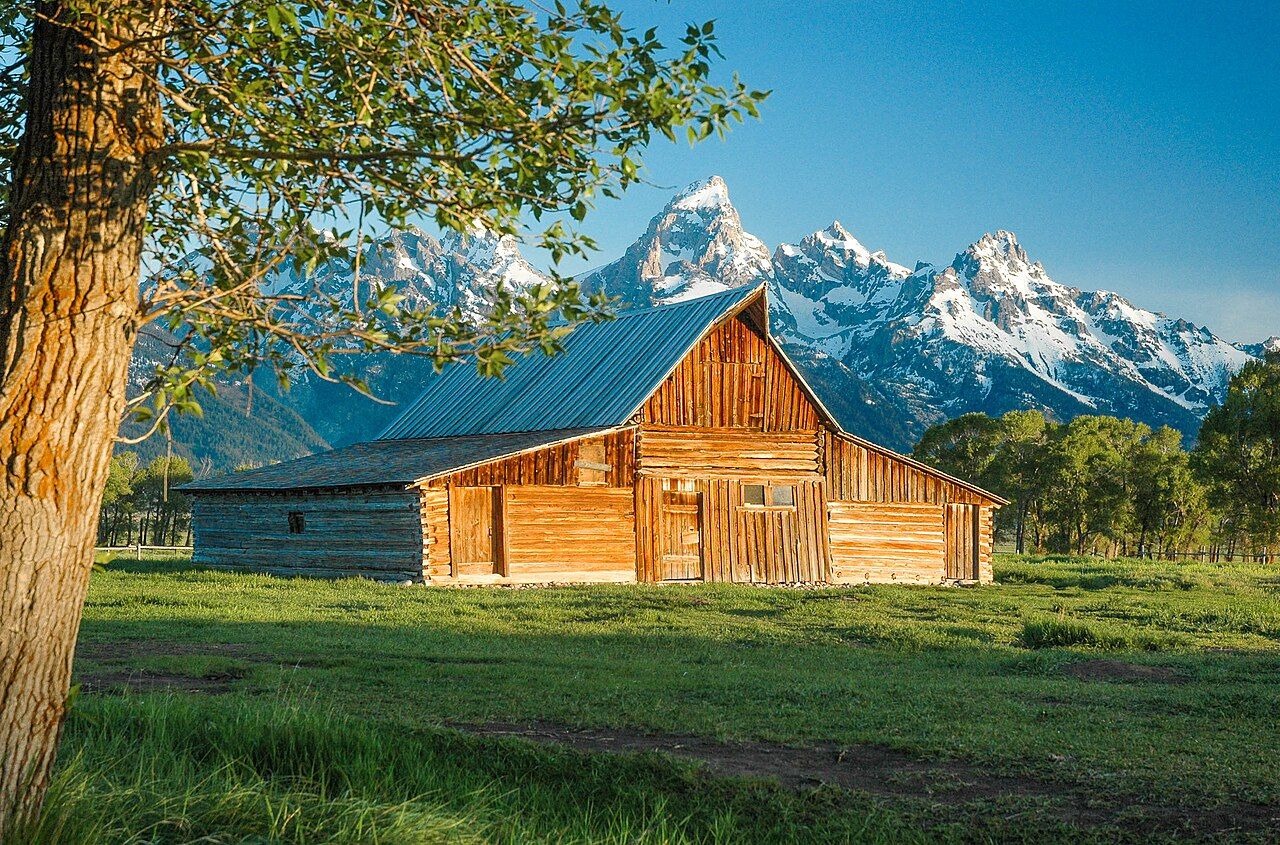
Mormon Row is a line of homesteads on the sagebrush flats east of the Snake River, settled around the turn of the twentieth century by Latter-day Saint families who dug irrigation ditches and farmed land most people thought too dry and too cold. Most of the houses are gone or empty now, but a handful of buildings remain, and two of the barns have become some of the most photographed farm structures in the country. The reason is simple: they stand in open ground with the Teton Range filling the western sky behind them, and at sunrise the light hits the barns and the peaks at the same moment.
The site sits inside Grand Teton National Park and is a public historic district. You can walk the lane and the open ground around the buildings, but the structures themselves are fragile, and the park asks visitors to stay off them and out of them.
Two barns, two families
People say "the Moulton barn" as if there were one. There are two, built by brothers, and they look quite different.
The T. A. Moulton barn
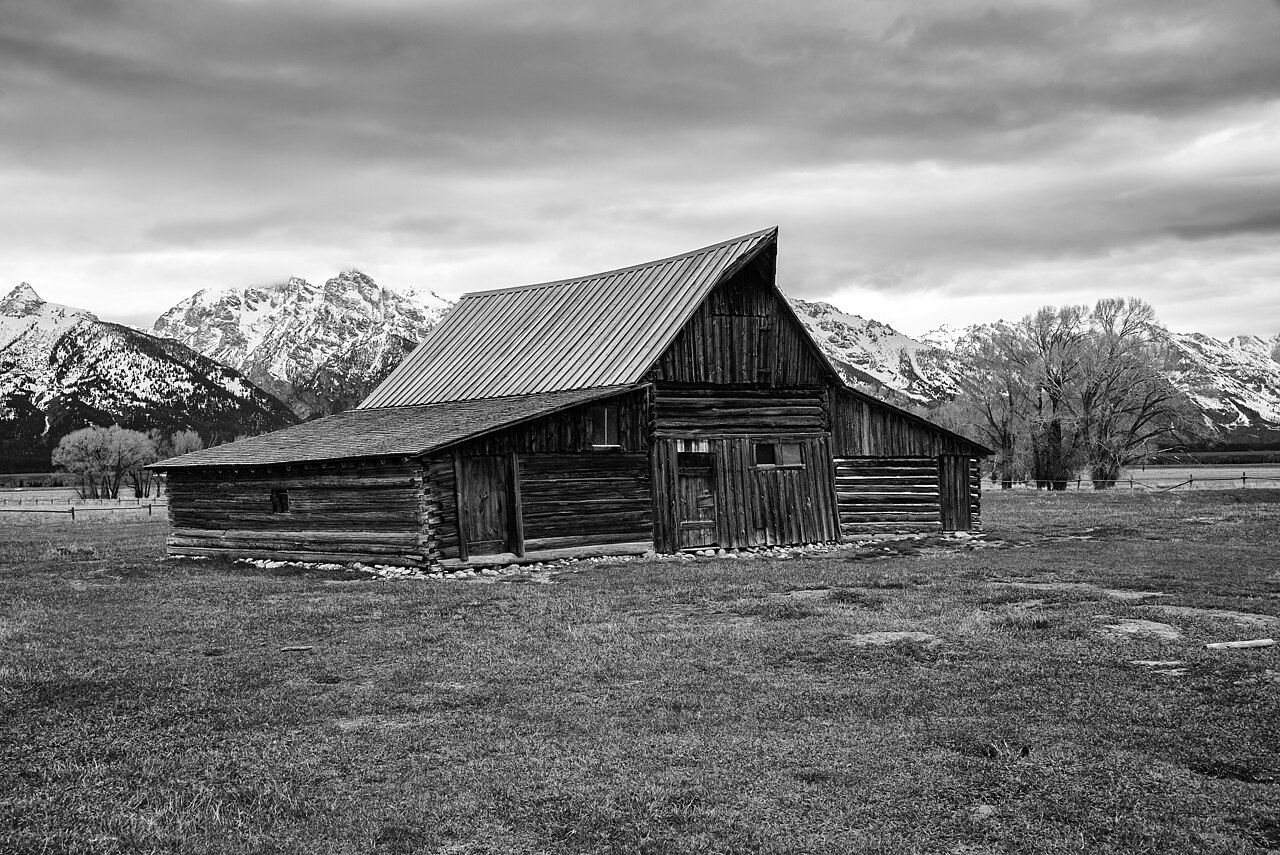
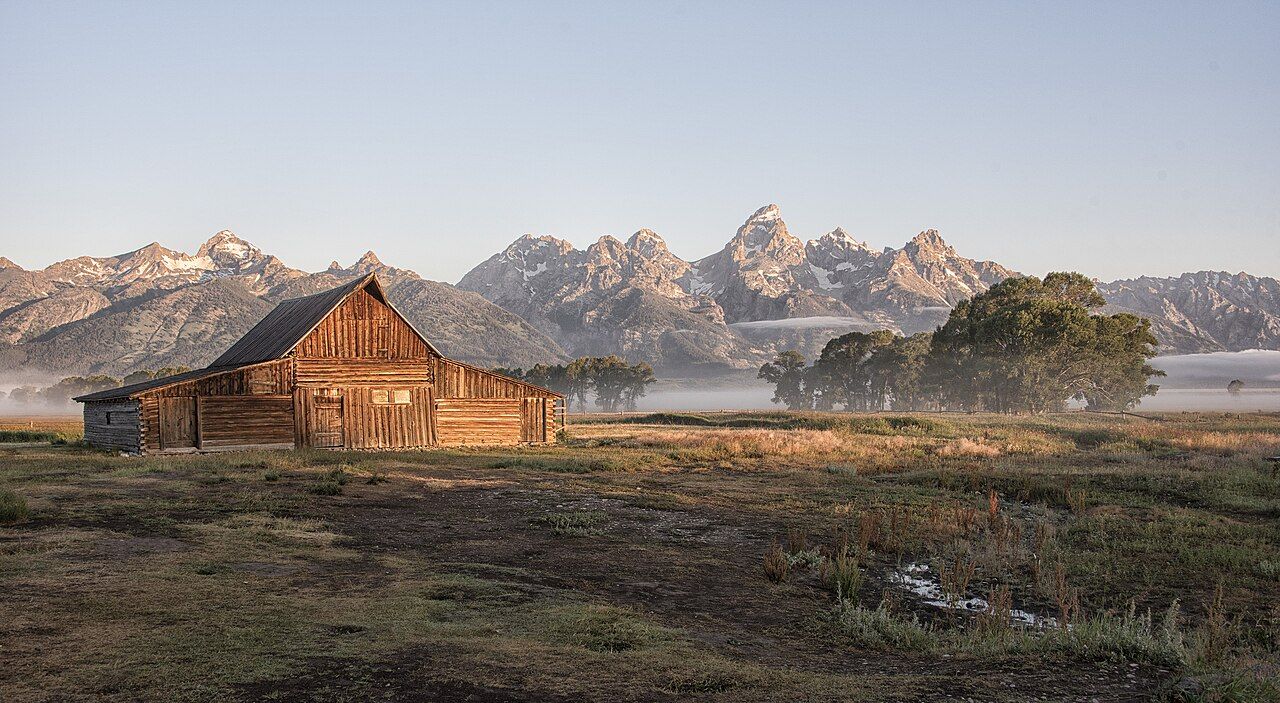
The northern barn, built by Thomas Alma Moulton and his sons over many years, has the tall central section with lower sheds on each side. This is the one you have seen on calendars, usually framed with the Grand Teton rising just above its roofline. It stands a little apart from other buildings, which makes it easy to isolate in the frame.
frame info
Gillfoto · CC BY-SA 4.0The John Moulton homestead
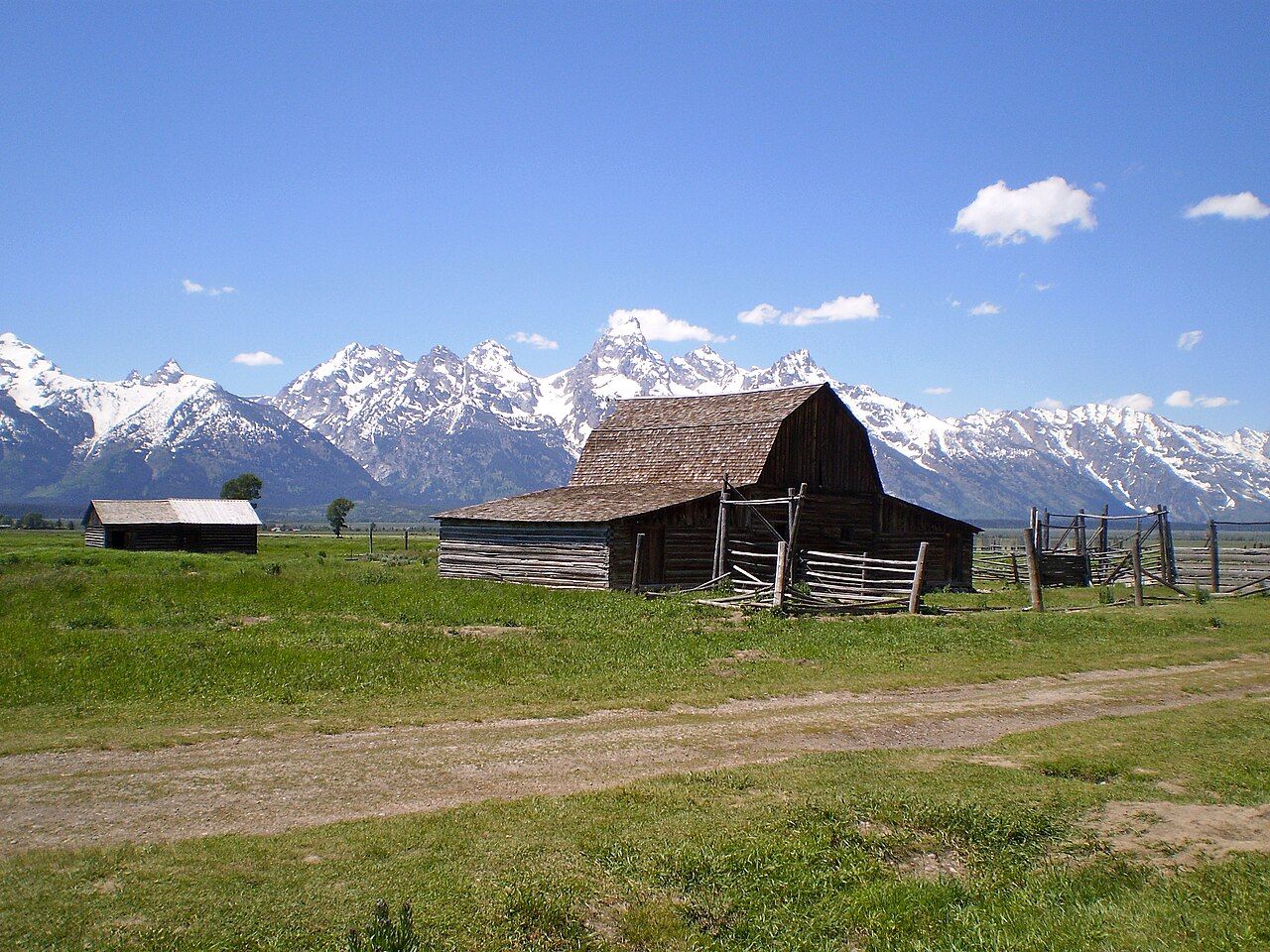
The southern cluster belonged to John Moulton. Its barn has a steep, flared roof, and nearby stand a pink stucco house, a few sheds and old corrals. The extra structures give you more to work with if you like foreground clutter and fence lines leading into the frame, and in some light this cluster makes the stronger picture.
frame info
ChadKroll · CC BY-SA 4.0Where to stand
The barns face roughly west toward the range, which means the morning sun comes from behind you and lights both the wood and the peaks. That is why almost everyone shoots here at dawn and why evening is a different, flatter proposition: by late afternoon the mountains are backlit and the barns sit in their own shade.
For the T. A. Moulton barn, the classic position is on the open ground to the east and slightly south of the building, far enough back that a moderate wide-angle or a normal lens holds the whole barn with the Grand Teton above it. Walk a few steps left or right and watch how the peak moves relative to the roof. A small shift changes the picture a great deal, and the best alignment is often not where the first arrivals have planted their tripods.
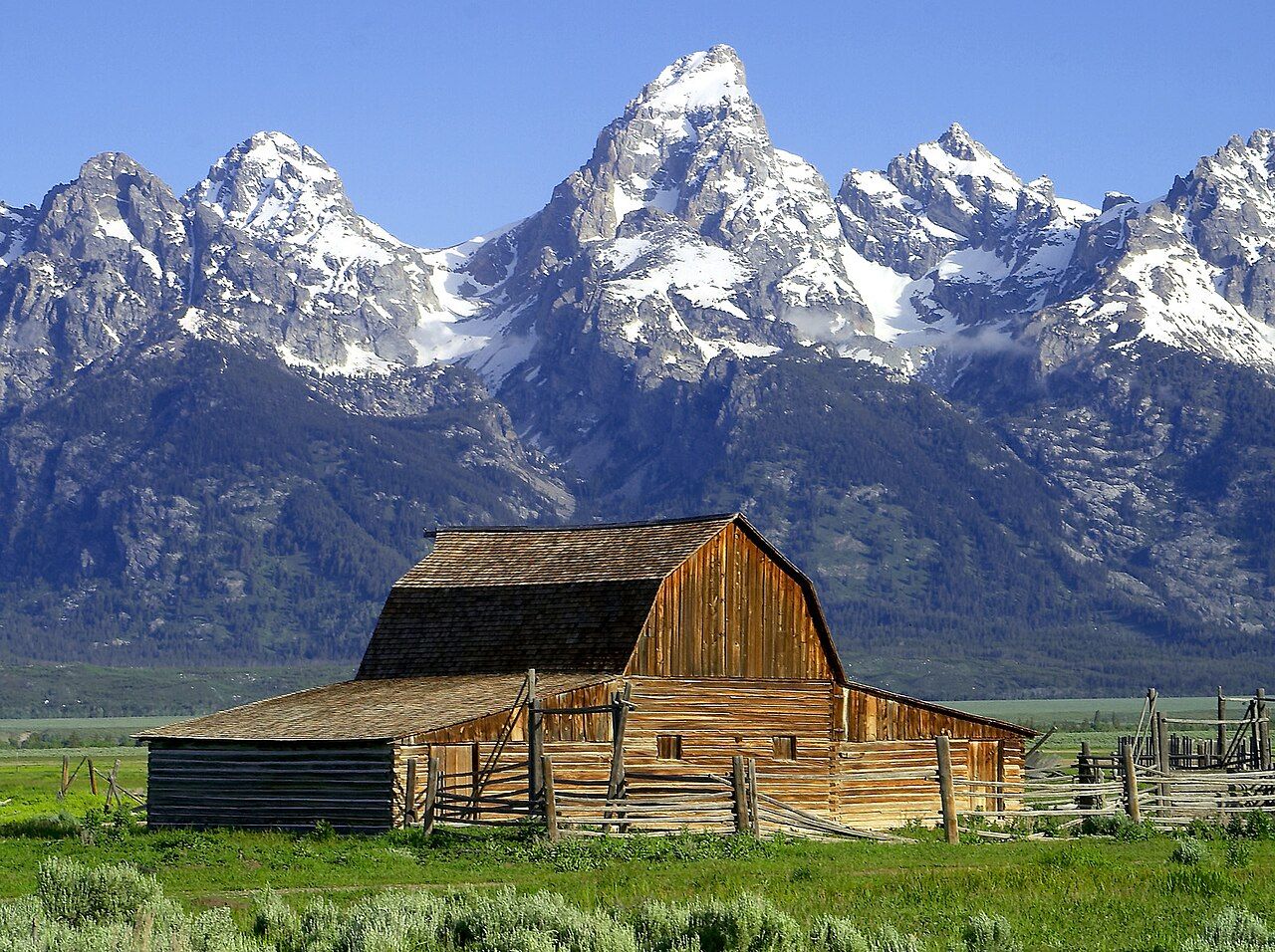
For the John Moulton barn, try standing back along the lane so the corral rails run toward the barn. A short telephoto from farther away compresses the range so that the mountains loom larger behind the roof, which is the look of the picture below.
frame info
Jon Sullivan, PD Photo · Public domain
Look for a cottonwood or a fence post you can use as a frame on one edge. The large cottonwoods around the T. A. Moulton barn throw shadows across the grass early on, and catching the sunlit barn between dark tree trunks gives depth without much effort.
Sunrise timing by season
The best light lasts only a few minutes. First the highest summits turn pink, then the glow slides down the face of the range, and only after that does direct sun reach the barns on the valley floor. If you want both mountain and barn lit warm, the window is short, so be set up before the peaks catch the first colour.
- June and July: sunrise comes very early, well before six in high summer. Grass is green, the flats can be wet with dew, and there is often still snow on the upper peaks.
- August: later sunrises, drier grass, and in some years smoke from distant wildfires that softens the range or hides it entirely.
- September and early October: the cottonwoods turn gold, frost is common at dawn, and on cold still mornings ground fog can lie across the flats. This is many photographers' favourite season here.
- Winter: the roads to the barns are not maintained for cars in the snow season, so reaching them means a ski or snowshoe trip.
frame info
Gillfoto from Juneau, Alaska, United States · CC BY-SA 4.0Low fog is worth watching for. On mornings after a cold, clear night, mist can rise from the river bottoms and drift around the cottonwoods, separating the barn from the mountains like a layer of tissue. The best morning here is often the one that starts with low cloud and clears at the last moment.
The best morning here is often the one that starts with low cloud and clears at the last moment.
It is also worth staying after the first glow fades: the softer light twenty minutes later suits black-and-white work and shows the grain of the logs. You can read more about these shifts in the valley's light and seasons.
Next frameSchwabacher Landing and its reflectionsCrowds, wildlife and manners
On a summer morning you will rarely have Mormon Row to yourself. Photographers start arriving well before dawn, and by sunrise the best ground in front of the T. A. Moulton barn can hold dozens of tripods. Arrive early, set up quietly, keep headlamps pointed at the ground and avoid walking through other people's frames once the light starts. If someone has taken the spot you wanted, the John Moulton barn a short drive south is usually less busy.
The flats around the barns are open range for wildlife. Bison herds often move through in summer, and pronghorn graze the sagebrush. Bison look slow and are not. Park rules require you to stay at least 25 yards from bison and other large animals, and much farther is wiser, especially in the late summer rut. If a herd is close to the barns, use a longer lens from the road rather than walking out. Our page on bison behaviour and warning signs explains what to watch for, and wildlife photography ethics covers the wider rules, including the ban on drones in national parks.
Respecting the buildings
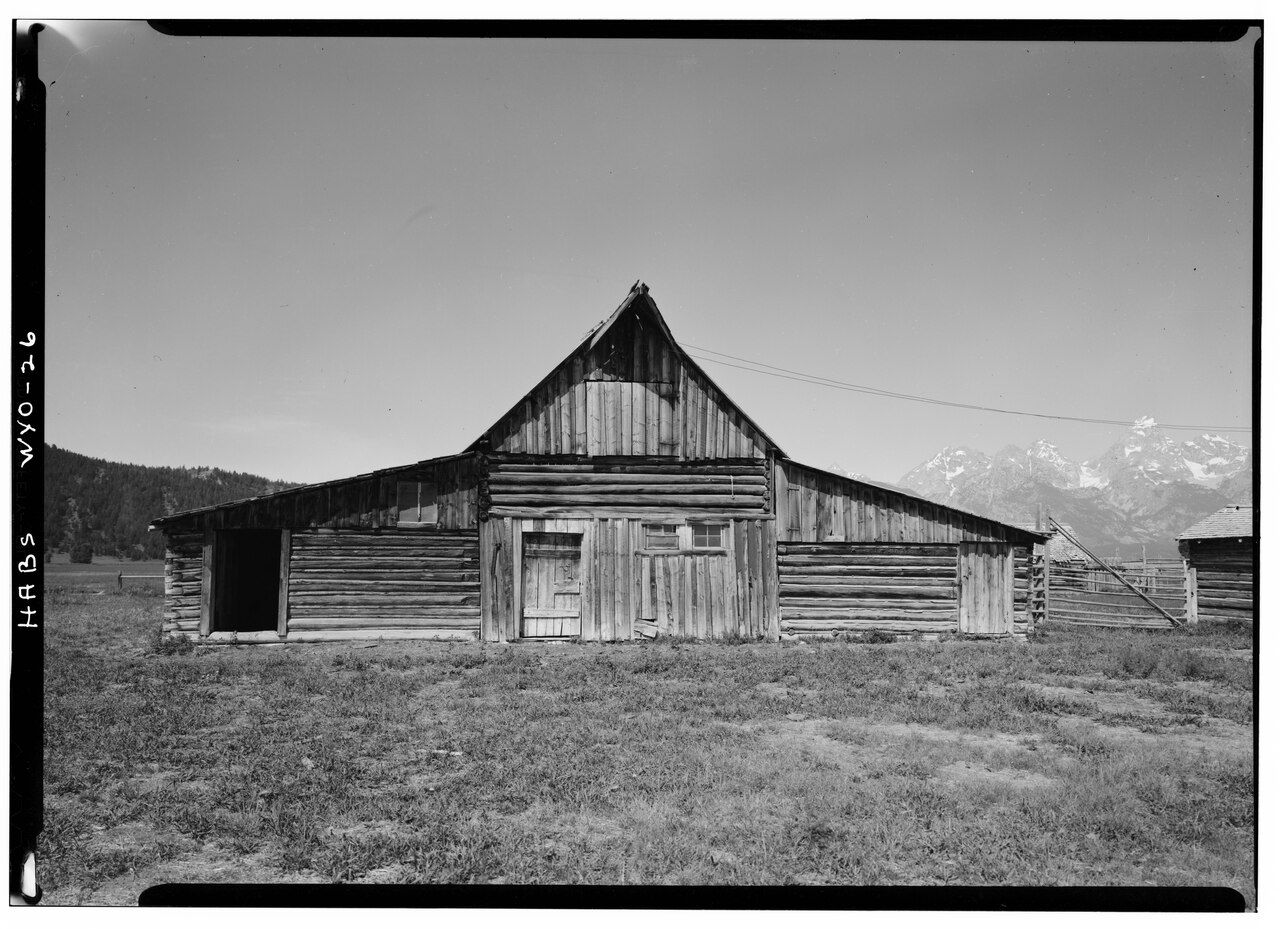
The barns are more than a century old, and they survive because people have chosen to keep them standing. Restoration work has stabilised roofs and foundations, but the wood is old and the structures are not built for visitors.
frame info
Huntsman, Al · Public domain- Do not climb on fences, corrals or the buildings themselves.
- Stay out of the barns and houses, even where a door hangs open.
- Leave nails, boards and anything else on the ground where it lies.
- Park only in the marked pullouts, never on the grass or sagebrush.
- Pack out everything, including the small things like lens caps and wrappers.
The surrounding area is managed as a historic district, and rules about access, parking and seasonal closures can change.
Combining it with other stops
Mormon Row works well as the first stop of a long morning. After sunrise, the light is still good for an hour or more at viewpoints along the main highway, and the Snake River Overlook is a short drive north. Later in the morning, the drive toward Moran and Oxbow Bend can turn up moose, elk and pelicans along the river. If you are staying in town, the barns are within easy reach before dawn, and you can return to Jackson for breakfast once the light turns harsh.
Mid-morning to late afternoon is not wasted time at the barns, though. Summer thunderheads often build over the range after midday, and a dark sky behind sunlit wood can make a dramatic frame. It is less predictable than sunrise, and that is part of the appeal.